R. Bras. Zootec.30/out/2026;55:e20250175.
Can silvopastoral systems with legume trees affect the spatial distribution of cattle dung in grazing lands?
Carolina Câmara Lira
 , José Carlos Batista Dubeux Junior
, Mércia Virginia Ferreira dos Santos
, Erinaldo Viana de Freitas
, Dayanne Camelo
, Erick Rodrigo da Silva Santos
, Igor Lima Bretas
ABSTRACT
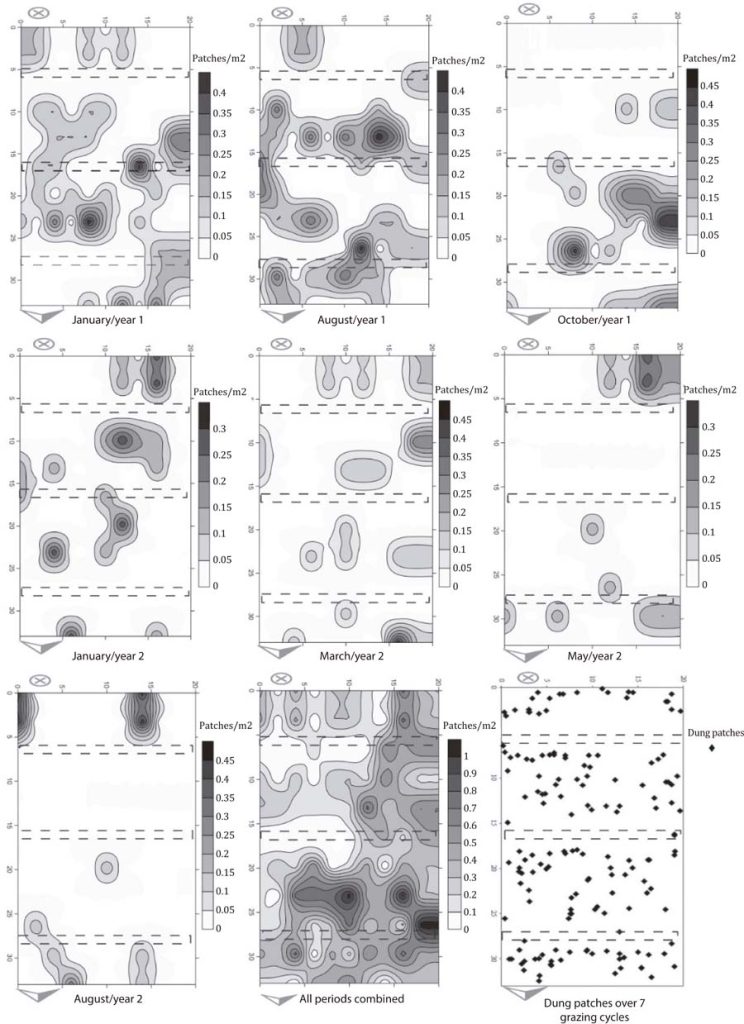
Animal excreta represent one of the primary pathways for nutrient return to pastures. We investigated the spatial distribution pattern of dung pads during seven grazing cycles over two years and the nutrient concentration in forage and cattle dung in different systems in a subhumid tropical region. The treatments were: (I) brachiaria grass (Brachiaria decumbens syn. Urochloa decumbens Stapf R. D. Webster) + gliricidia (Gliricidia sepium (Jacq.) Kunth ex. Walp.; B+G); (II) brachiaria grass + sabia (Mimosa caesalpiniifolia Benth.; B+S); (III) brachiaria grass + N fertilization (B+N); and (IV) brachiaria grass without fertilization (B), allocated in a randomized complete block design with four replications. The spatial distribution of cattle dung was assessed using geostatistical approaches. The N concentration in the forage grass was significantly greater (P<0.05) in B+S (31 g kg−1) compared with B (19.3 g kg−1) during the first evaluation (January), with no statistical difference among the other treatments or evaluations (P>0.05). Within treatments, N concentration was higher in B+G and B+S in January than in the other evaluations (P<0.05). The nutrient concentrations in cattle dung were similar across all systems (P>0.05), varying only among evaluations (P<0.05). Similarly, there were no differences in the spatial distribution of cattle dung among systems (P>0.05), which followed an aggregated distribution pattern throughout the study. The inclusion of leguminous trees did not affect nutrient excretion or the spatial distribution of cattle dung within the tree arrangement and conditions evaluated. These findings suggest that effective nutrient redistribution depends on tree development and appropriate management scale, supporting improved nutrient cycling in grazing systems.
Palavras-chave: cattle excreta; Gliricidia sepium; Mimosa caesalpiniifolia; nutrient cycling; silvopastoral systems