R. Bras. Zootec.20/mar/2026;55:e20250020.
Forage peanut as a sustainable alternative to nitrogen fertilization for maintaining pasture productivity after recovery
Daniel Rume Casagrande
 , Gustavo Dias Guimarães
, Luana Ruiz dos Santos
, Lucas Peralta Carneiro Borges
, Mateus Pies Gionbelli
, Robert Michael Boddey
, Adenilson José Paiva
, Bruno Grossi Costa Homem
, Gustavo Dias Guimarães
, Luana Ruiz dos Santos
, Lucas Peralta Carneiro Borges
, Mateus Pies Gionbelli
, Robert Michael Boddey
, Adenilson José Paiva
, Bruno Grossi Costa Homem
ABSTRACT
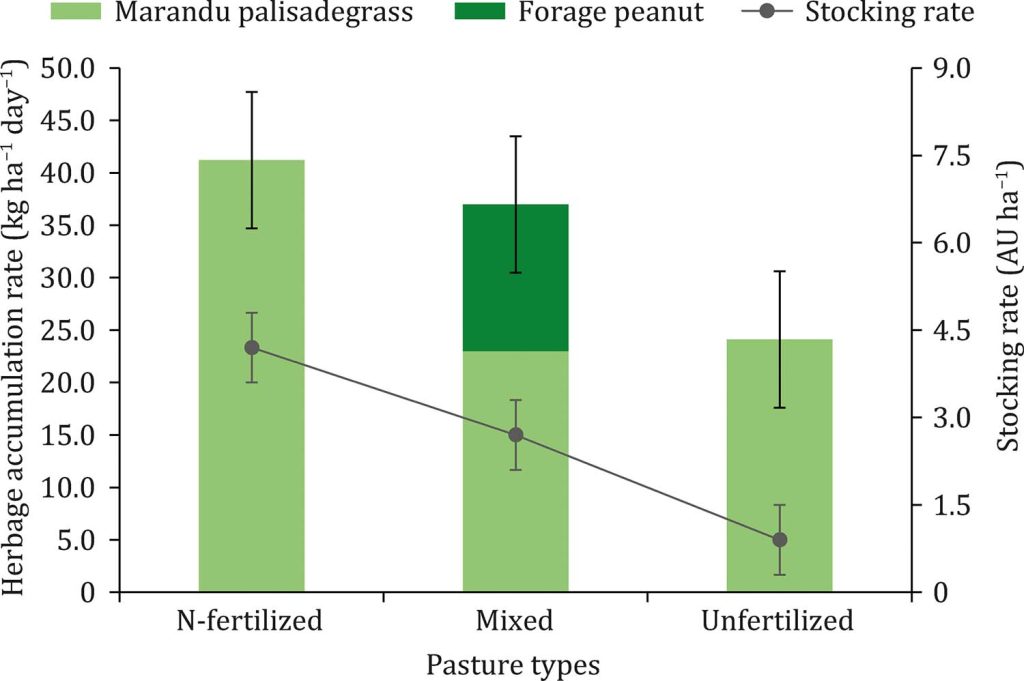
The objective of this study was to investigate the influence of nitrogen (N) input via fertilizer or through the inclusion of an N-fixing legume mixed with grass on canopy structural characteristics, forage production, and stocking rate in grazing systems. Three pastures type (PT), with Marandu palisadegrass (U. brizantha), were assessed: i) monoculture without N fertilizer application (Unfertilized); ii) monoculture fertilized with 150 kg N ha⁻1 year⁻1 (N-fertilized); iii) and mixed pasture with forage peanut (A. pintoi), without N fertilizer (Mixed). The treatments were managed under mob stocking with variable stocking rate. The canopy height target was between 25 and 30 cm (pre-grazing), and 15 cm (post-grazing). Beef cow-calf pairs were used (529 ± 49 kg cows and 80 ± 29 kg calves) for grazing. The pre-grazing total herbage mass was not influence for the PTs (P = 0.111), which averaged 7,234 kg ha⁻1. The greatest and lowest pre-grazing herbage mass were recorded for the N-fertilized and Unfertilized. The N-fertilized and Mixed had the greatest post-grazing herbage mass (P = 0.012). The legume proportion in the Mixed was on average 30.5%. The N-fertilized and Mixed showed the greatest herbage accumulation rate. The lowest herbage accumulation rate was recorded in the Unfertilized. Stocking rate was reduced by 35.7 and 78.5% in the Mixed and Unfertilized, respectively, compared with the N-fertilized pasture, with the Unfertilized averaging 0.9 AU ha⁻1. Overall, N-input is crucial for maintaining and supporting adequate carrying capacity in pasture ecosystems. Thus, forage peanut legume provides a way to add N with lower economic and environmental costs.
Palavras-chave: Arachis pintoi; beef cattle; Brachiaria; degraded pasture; mixed pasture