R. Bras. Zootec.08/jul/2026;55:e20250039.
Effect of supplementation with selenium proteinate and sodium selenite on performance, digestibility, intestinal integrity, and expression of selenoproteins in weaned piglets
Jorge Luiz Santos de Almeida
 , Leonardo Augusto Fonseca Pascoal
, Ricardo Romão Guerra
, Terezinha Domiciano Dantas Martins
, Patrícia Emília Naves Givisiez
, Pedro Henrique Watanabe
, Jonathan Mádson dos Santos Almeida
, João Marcos Monteiro Batista
, Maria Pricila Ferreira Hermínio
, Verônica Lisboa Santos
, Wydemberg José de Araújo
, Leonardo Augusto Fonseca Pascoal
, Ricardo Romão Guerra
, Terezinha Domiciano Dantas Martins
, Patrícia Emília Naves Givisiez
, Pedro Henrique Watanabe
, Jonathan Mádson dos Santos Almeida
, João Marcos Monteiro Batista
, Maria Pricila Ferreira Hermínio
, Verônica Lisboa Santos
, Wydemberg José de Araújo
ABSTRACT
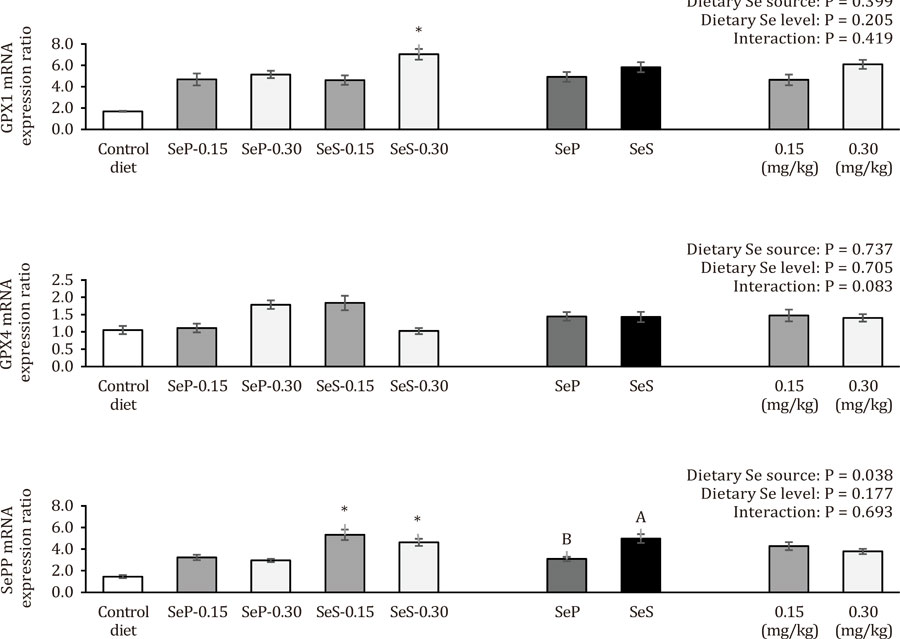
The study was carried out with the objective of investigating the enrichment of weaned piglet diets with selenium proteinate (SeP) and sodium selenite (SeS) at two inclusion levels. A total of 40 piglets, averaging 6.60 ± 1.06 kg, were assigned to five dietary treatments: a control diet, and diets supplemented with selenium proteinate (0.15 or 0.30 mg/kg) or sodium selenite (0.15 or 0.30 mg/kg). The SeP-0.30 diet reduced average daily feed intake (ADFI) (P<0.05) in both periods and average daily gain (ADG) (P = 0.017) in the second period. Diets with selenium proteinate improved the digestibility of dry matter (DM; P = 0.024) and organic matter (OM; P = 0.024). All selenium-enriched diets increased selenium retention (P<0.05). The addition of 0.30 mg/kg of selenium reduced villus height (VH) (P = 0.001), villus width (VW) (P = 0.001), crypt depth (CD) (P<0.0001), and mitotic rate (P = 0.031). Sodium selenite reduced apoptosis in the jejunal epithelium (P = 0.020) and increased hepatic selenoprotein P (SePP) expression (P = 0.038). High concentrations of sodium selenite elevated hepatic selenoproteins, serum creatinine (CRC), and Immunoglobulin A (IgA) concentrations. Supplementation with sodium selenite should not exceed 0.30 mg/kg, whereas selenium proteinate is recommended at up to 0.15 mg/kg. Increasing selenium, particularly as proteinate, yields positive results, but levels above 0.30 mg/kg may be detrimental.
Palavras-chave: antioxidant; immunity; oxidation process; serum parameters