R. Bras. Zootec.04/mar/2026;55:e20250112.
Different dry matter contents on the fermentation and preservation of wilted ryegrass silage with or without microbial inoculants
Juliana Aparecida de Assis
 , Maryon Strack Dalle Carbonare
, Patrick Schmidt
, Maryon Strack Dalle Carbonare
, Patrick Schmidt
ABSTRACT
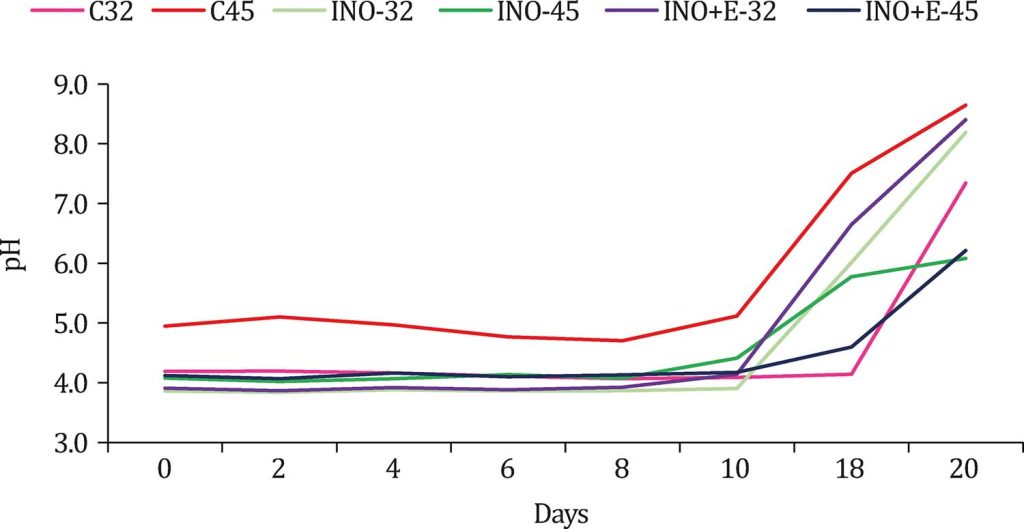
The objective of this study was to evaluate the effects of two different dry matter contents at ensiling on the chemical composition, fermentation products, microbial profile, and aerobic stability (AS) of wilted ryegrass (Lolium multiflorum L.) silages, with or without microbial inoculants. The ryegrass was wilted in the field until it reached 32 or 45% DM. In addition to DM contents, the effect of adding or not adding microbial inoculants to the forage was evaluated, resulting in the following treatments: Control – no additive (C); commercial inoculant – Magniva Platinum 2 (INO); and commercial inoculant plus enzymes – Magniva Platinum 3 (INO+E). The silos were stored for 62 days. In the 32% DM treatment, the inoculated silages showed higher DM content and lower pH than the control, indicating a more favorable fermentation profile. Silages at 32% DM exhibited lower pH (3.97), higher levels of lactic, acetic, and propionic acids, and a greater population of LAB. The lower DM treatments also showed reduced DM and gas losses, absence of effluent, and lower DM losses during aerobic exposure. The inoculants increased lactic acid production and decreased propionic and butyric acid concentrations. At 32% DM, INO and INO+E inoculants significantly improved in vitro estimates of DM, OM, and NDF digestibility. Yeast and mold counts were low (<10-4), with no colony development at the lowest dilution tested. Total DM (8.6 g kg−1 DM), gas (8.1 g kg−1 DM), and effluent losses (0.51 kg/ton wet basis) were minimal across all treatments. At 32% DM, silages treated with INO presented negative values for gas and DM losses. AS was high for all silages (353 and 328 h for treatments 32 and 45% DM, respectively), with greater stability observed in 32% DM treatments. The inoculants enhanced AS in 45% DM silages and reduced DM losses over 20 days of aerobic exposure. The 32% DM harvest led to better quality silages. Microbial inoculants were effective in improving fermentation and preservation of ryegrass silages by reducing fermentative losses at 32% DM and enhancing aerobic stability at 45% DM.
Palavras-chave: aerobic stability; chemical composition; cool-season forage; forage conservation; pH