R. Bras. Zootec.26/ago/2025;54:e20240135.
The optimal concentration of digestible methionine plus cysteine for broiler chicken performance determined by statistical models
Francielle de Oliveira Marx
 , Vivian Izabel Vieira
, Marcus Vinicius Niz Alvarez
, Emanuele Cristiny Goes
, Ananda Portella Félix
, Simone Gisele de Oliveira
, Alex Maiorka
, Vivian Izabel Vieira
, Marcus Vinicius Niz Alvarez
, Emanuele Cristiny Goes
, Ananda Portella Félix
, Simone Gisele de Oliveira
, Alex Maiorka
ABSTRACT
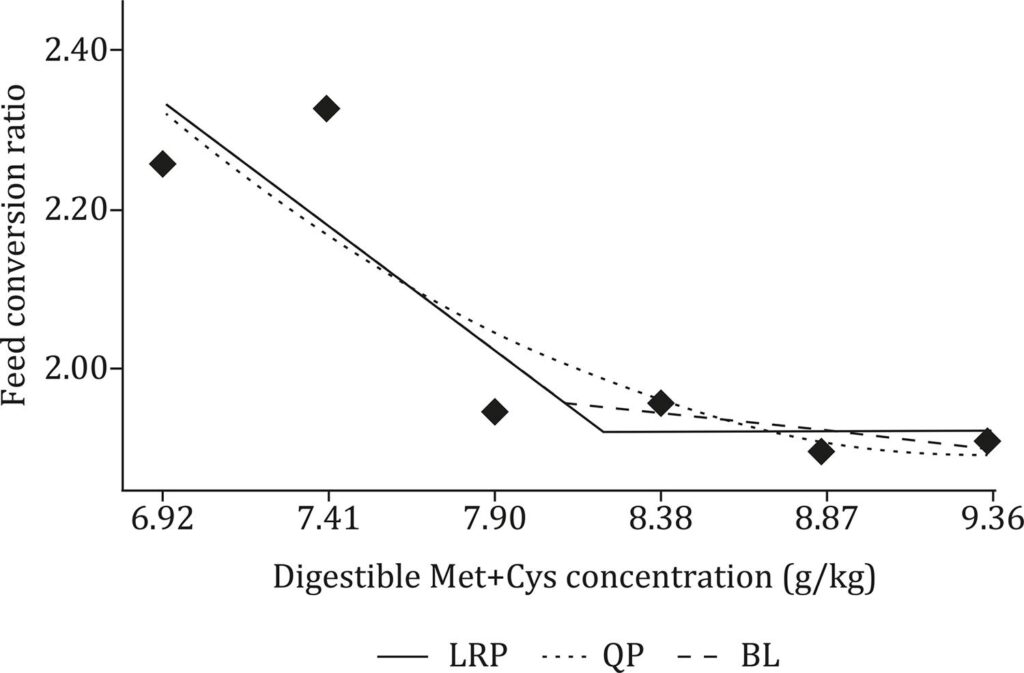
The objective of this study was to determine the optimal concentration of digestible methionine plus cystine (Met+Cys) for broiler chickens. We allocated 1,296 male broiler chickens in a completely randomized design with six treatments and nine replicates of 24 broiler chickens each. From 1 to 21 days old, broiler chickens were fed a basal diet. At day 21, the experimental diets were offered, which consisted of a basal diet (with no inclusion of synthetic methionine) and five diets supplemented with increasing concentrations of DL-methionine, which supplied 7.70, 8.29, 8.89, 9.48, 10.07, and 10.67 g/kg Met+Cys in the grower phase (21 to 35 d); and 6.92, 7.41, 7.90, 8.38, 8.87, and 9.36 g/kg Met+Cys in the finisher phase (36 to 42 d). Feed intake (FI), body weight gain (BWG), feed conversion ratio (FCR), methionine intake, efficiency of methionine utilization, carcass yield, breast yield, and abdominal fat percentage were recorded. The quadratic polynomial (QP) regression, segmented, linear response plateau (LRP), and broken-line regression (BL) statistics were used to calculate the optimal Met+Cys concentrations for BWG and FCR. In the grower phase, FI was not affected by the increasing concentrations of Met+Cys, but it was linearly reduced during the finisher period (P<0.05). Greater Met+Cys concentrations positively affected the other analyzed variables in every phase (P<0.05). During the grower phase, the QP and LRP models were better fit to the BWG data, respectively indicating 10.30 and 9.10 g/kg optimal Met+Cys concentrations, whereas the QP model estimated 10.03 g/kg Met+Cys for optimal FCR. For the finisher phase, LRP was a better fit to BWG and FCR data, respectively estimating 8.20 g/kg optimal Met+Cys concentrations.
Palavras-chave: digestible Met+Cys; optimal concentration; performance; statistical model