R. Bras. Zootec.12/set/2025;54:e20240204.
Nutrient profile and performance of commercially available grower feeds in Brazil for the semi-intensive culture of juvenile Penaeus vannamei raised across different water salinities
Felipe Nobre Façanha
 , Alberto Jorge Pinto Nunes
ABSTRACT
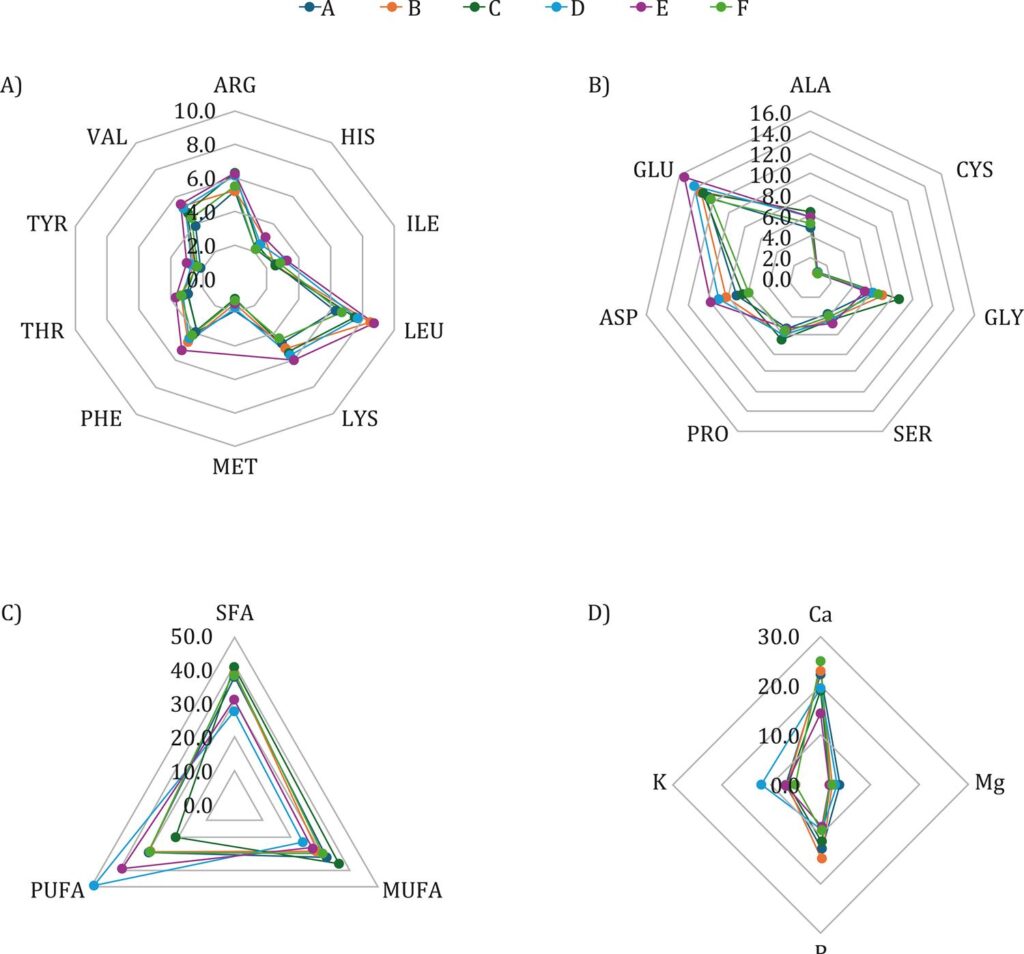
This study assessed the nutrient profiles of major grower shrimp feeds in Brazil used in semi-intensive farming of Penaeus vannamei and their impact on shrimp growth under optimal (15.8 ± 0.14 ppt), hypoosmotic (3.9 ± 0.57 ppt), and hyperosmotic (41.8 ± 0.62 ppt) salinities. Juvenile shrimp (0.85–1.60 g) were stocked at 50 animals/m2 in 40 outdoor tanks (1 m3) and fed across three consecutive trials lasting 63 to 86 days. Dietary nutrient composition varied widely, with crude protein ranging from 38.2 to 41.2%, carbohydrates from 28.5 to 43.8%, crude fat from 6.7 to 12.1%, and ash content from 10.7 to 20.2%. There were also variations in gross energy (16.2–18.5 MJ/kg), macrominerals, amino acids (AA), and essential fatty acids (EFA). Principal Component Analysis and hierarchical clustering identified EFA, AA, and minerals as key factors driving feed variability. Growth performance under optimal and hypoosmotic salinities was largely attributed to EFA levels. Feed E, with the highest EFA content, supported superior growth, followed by feeds D and A. This ranking (feed E > feed D > feed A > feed F, feed B, and feed C) aligned with observed growth, highlighting the critical role of EFA in shrimp performance under these salinities. Under hyperosmotic conditions, shrimp growth was similar across most feeds, indicating high salinity limited growth. The study suggests that specific nutrient profiles, particularly those enriched in EFA, support growth more effectively under optimal and hypoosmotic conditions, while others are less effective under high salinity stress. The findings emphasize the need for adaptive feed formulations to meet metabolic demands, offering valuable insights for feed selection in regions with suboptimal salinity conditions.
Palavras-chave: amino acids; essential fatty acids; nutrient variability; osmotic stress; shrimp feed formulation