R. Bras. Zootec.29/out/2026;55:e20240032.
Insights of Nauphoeta cinerea, as a protein source for replacing fish meal and soybean meal in tropical gar, Atractosteus tropicus, and Nile tilapia, Oreochromis niloticus, diets
Uriel Rodríguez-Estrada
 , Gil Martínez-Bautista
, Simrith Elizabeth Córdova-de la Cruz
, Susana De la Rosa-García
, Félix Maldonado-Desena
, César Antonio Sepúlveda-Quiroz
, Graciela Pérez-Jiménez
, Mayra Lizett González-Félix
, Martin Perez-Velazquez
, Rafael Martínez-García
, Otilio Méndez-Marín
, Carlos Alfonso Álvarez-González
ABSTRACT
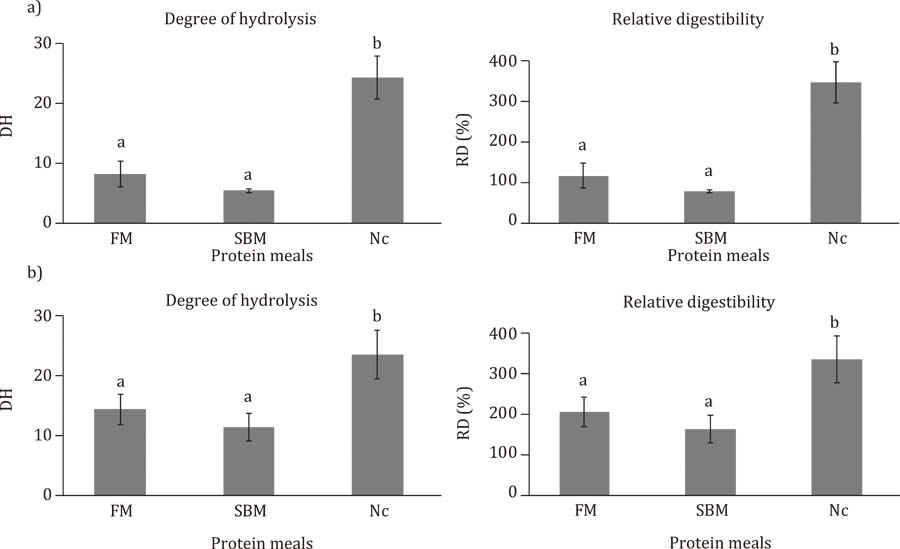
This study aims to investigate the proximate composition, heavy metal contents, antimicrobial activity, and in vitro digestibility of Nauphoeta cinerea (Nc) as a replacement for fish meal (FM) and soybean meal (SBM) in diets for a carnivorous (tropical gar, Atractosteus tropicus) and an omnivorous (tilapia, Oreochromis niloticus) fish. Nauphoeta cinerea were fed a formulated diet based on fruits, vegetables, beef liver, and grains. They had an acceptable level of protein (46.50 g 100 g−1) and high contents of lipids (14.49 g 100 g−1) compared with FM and SBM. Amino acid and free fatty acid (FFA) profiles more closely resembled previously reported levels in insect meals than those of FM and SBM. The mineral content of Nc was similar to that of both FM and SBM. The heavy metal contents of Nc were within standard permissible limits established for FM and SBM. Nauphoeta cinerea showed a chitin content of 4.20±0.08% (percentage of glucosamine), equivalent to 42.02±0.08 µg of glucosamine (chitin) per mg of insect meal. The antimicrobial assay showed that Nc did not inhibit the growth of bacterial species with probiotic properties commonly present in fish intestinal microbiota. The in vitro digestibility of Nc performed better in tilapia than in tropical gar during the acid stage. During the alkaline stage, the degree of hydrolysis (DH) and relative digestibility (RD) of Nc were higher than that of FM and SBM. Nauphoeta cinerea is nutritionally feasible (in terms of proximal composition), digestible (in terms of in vitro digestibility), safe (in terms of heavy metals contents), and biologically functional (in terms of antimicrobial activity) as a replacement for FM and SBM in the diets of omnivorous and carnivorous fish.
Palavras-chave: Atractosteus tropicus; in vitro digestibility; insect meals; protein; quality assessment