R. Bras. Zootec.29/set/2025;54:e20240151.
Correlation and path analysis based on multi-trait BLUP as selection criteria for forage in Paspalum nicorae Parodi
Diógenes Cecchin Silveira
 , Annamaria Mills
, Rodrigo Sampaio
, Júlia Longhi
, Esandro Corrêa do Amaral
, Victor Schneider de Ávila
, Roberto Luis Weiler
, André Pich Brunes
, Carine Simioni
, Miguel Dall’Agnol
, Annamaria Mills
, Rodrigo Sampaio
, Júlia Longhi
, Esandro Corrêa do Amaral
, Victor Schneider de Ávila
, Roberto Luis Weiler
, André Pich Brunes
, Carine Simioni
, Miguel Dall’Agnol
ABSTRACT
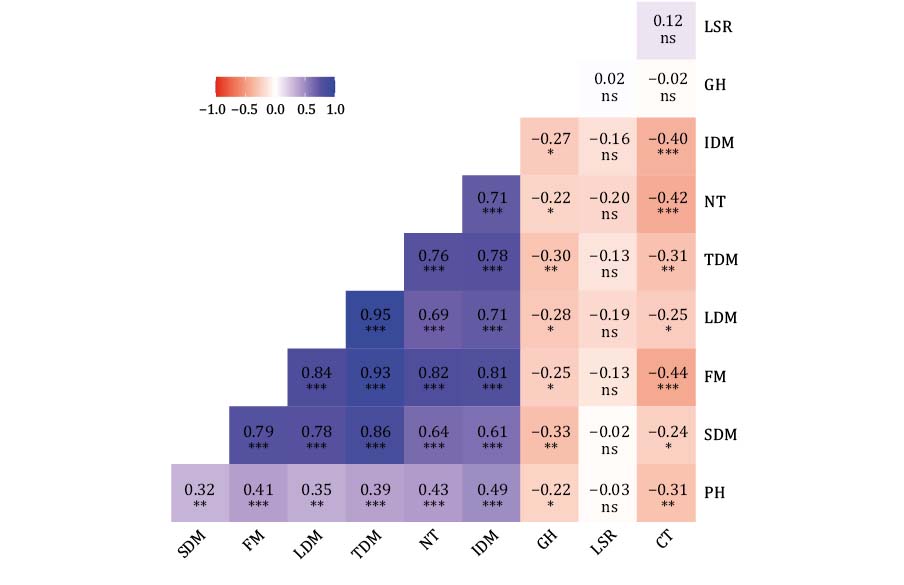
The objective of this study was to evaluate the associations among forage production related traits in Paspalum nicorae Parodi ecotypes and employ BLUP multi-trait path analysis as a selection criterion. Eighty-four ecotypes were grown in a randomized block experimental design with four replications and measured for three years. Measurements included number of tillers, fresh matter, leaf dry matter, stem dry matter, inflorescence dry matter, total dry matter, leaf:stem ratio, harvest index, cold tolerance, forage persistence, growth habit, and plant height. Variance components were estimated using maximum residual likelihood, and genetic correlation coefficients were obtained from the output of a mixed model. Subsequently, path analysis was performed, which used total dry matter as the dependent trait. Total dry matter showed positive and significant associations with most of the traits studied. This meant that indirect selection based on the number of tillers, height, and total fresh matter was a viable method to select for increased dry matter production. Multi-trait path analysis based on BLUP proved to be useful for studying associations between traits related to total dry matter and demonstrated that leaf dry matter has the greatest direct effect on total dry matter.
Palavras-chave: Brunswick grass; genetic correlation; mixed models; native grass