R. Bras. Zootec.29/set/2026;55:e20250161.
Phytochemical potential of Desmodium incanum and Paspalum notatum in native subtropical grasslands: tannins and tocopherol content
Cesar Henrique Espírito Candal Poli
 , Jalise Fabíola Tontini
, Aline Pericolo Sgiers
, Melissa Oda-Souza
, Renius de Oliveira Mello
, Juliano Henriques da Motta
, Filipe Martin de Campos
, James Pierre Muir
, Jalise Fabíola Tontini
, Aline Pericolo Sgiers
, Melissa Oda-Souza
, Renius de Oliveira Mello
, Juliano Henriques da Motta
, Filipe Martin de Campos
, James Pierre Muir
ABSTRACT
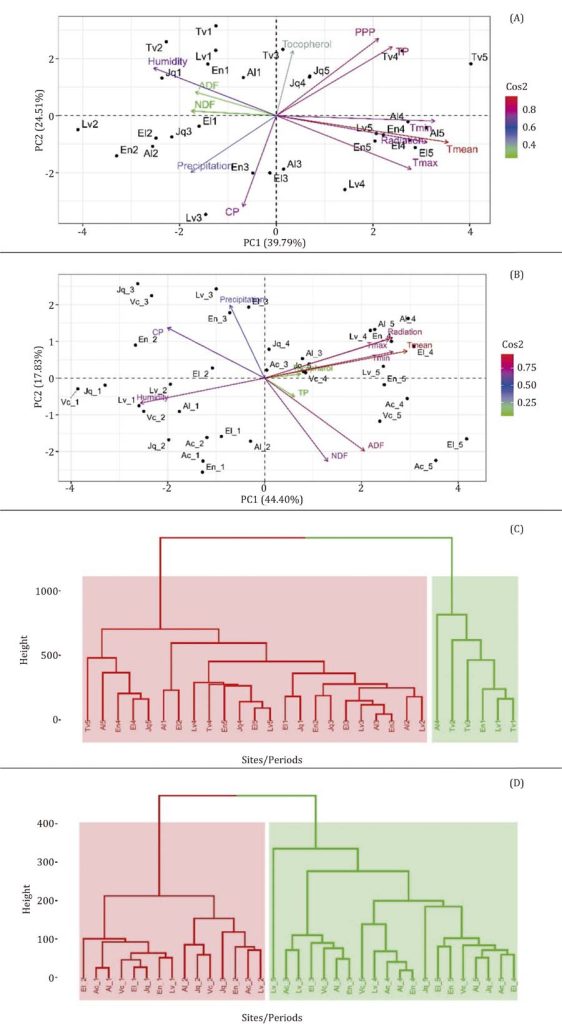
Condensed tannins and α-tocopherol are important antioxidants produced by forage plants, with potential benefits for grassland sustainability and ruminant productivity. The objective of this study was to quantify the concentrations of phenolic compounds in Desmodium incanum DC. and Paspalum notatum Flüggé in subtropical grasslands of the Brazilian Pampa and Atlantic Forest. Pasture samples were randomly collected from eight sites selected to represent different climatic conditions of the southernmost grasslands of Brazil. Six sites were located in the Pampa biome and two in the Atlantic Forest biome. The sampling protocol included collections during different periods of the year, representing the seasons as follows: summer (Jan-Feb), autumn (May-Jun), winter (Jul-Aug), spring (Sep-Oct), and spring-summer (Nov-Dec). D. incanum and P. notatum samples were collected and immediately stored in liquid nitrogen, then lyophilized, ground and the compounds were extracted for subsequent analysis. Condensed tannin concentration was estimated as bioreactive protein-precipitable phenolics (PPP). Different concentrations of total phenolics (TP), PPP and α-tocopherol were observed in D. incanum leaves across seasons. TP ranged from 63.91 to 242.71 g/kg dry matter (DM), PPP from 57.94 to 154.64 g/kg DM, and α-tocopherol from 435.06 to 905.12 mg/kg DM. In P. notatum leaves, TP ranged from 37.85 to 59.53 g/kg DM, while α-tocopherol varied from 10.89 to 95.56 mg/kg DM throughout the year. Air temperature, precipitation, relative humidity and solar radiation did not influence α-tocopherol levels (P>0.05). Air temperature and solar radiation were positively correlated with TP and PPP concentrations in D. incanum leaves. These findings indicate that D. incanum is a significant source of phenolic compounds and α-tocopherol in subtropical grasslands. Its antioxidant profile suggests a potential role in improving the quality of ruminant products, however seasonal and ontogenic variations must be considered when evaluating its nutritional value.