R. Bras. Zootec.05/dez/2025;54:e20240079.
In vitro ruminal fermentation of processed cottonseed and peanut meals with varying levels of rumen undegradable protein
Fernanda Rigon
 , Elaine Magnani
, Amanda Regina Cagliari
, Kalista Eloisa Loregian
, Ana Claudia Casagrande
, Bruna Roberta Amâncio
, David Augusto Bittencourt Pereira
, Henrique Almeida Machado Borges
, Hugo Fernando Monteiro
, Aline Zampar
, Marcos Inácio Marcondes
, Renata Helena Branco
, Pedro Del Bianco Benedeti
, Eduardo Marostegan Paula
, Elaine Magnani
, Amanda Regina Cagliari
, Kalista Eloisa Loregian
, Ana Claudia Casagrande
, Bruna Roberta Amâncio
, David Augusto Bittencourt Pereira
, Henrique Almeida Machado Borges
, Hugo Fernando Monteiro
, Aline Zampar
, Marcos Inácio Marcondes
, Renata Helena Branco
, Pedro Del Bianco Benedeti
, Eduardo Marostegan Paula
ABSTRACT
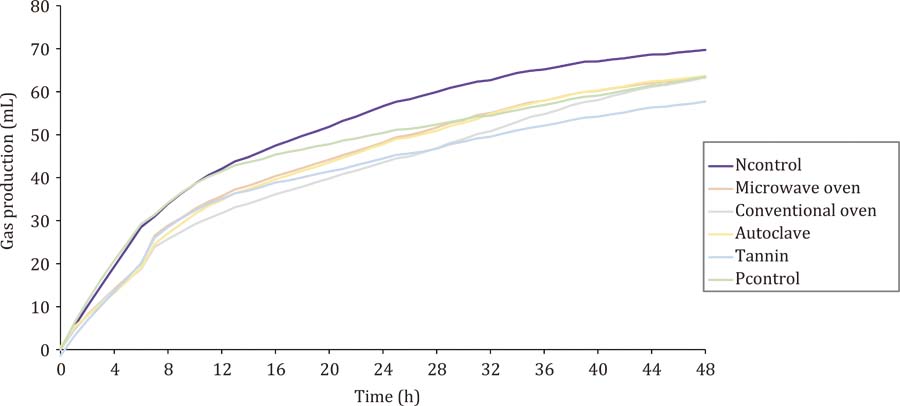
This study aimed to assess the ruminal fermentation of various cottonseed (Exp. 1) and peanut (Exp. 2) meals, each processed using different techniques and exhibiting varying levels of rumen undegradable protein (RUP). Six treatments were evaluated for each feed. For Exp. 1 (cottonseed meal): negative control (conventional meal; Ncontrol), microwave-heated (2 min) with 2% xylose, conventional oven-heated (90 min) with 2% xylose, autoclave-heated (8 min) with 2% xylose, tannin treatment (6% inclusion), and a commercial soybean-based product (Pcontrol). For Exp. 2 (peanut meal): negative control (conventional meal; Ncontrol), microwave-heated (6 min) with 2% xylose, conventional oven-heated (60 min) with 2% xylose, autoclave-heated (24 min) with 2% xylose, tannin treatment (6% inclusion), and a commercial soybean-based product (Pcontrol). An in vitro gas production (GP) system was used to evaluate gas production, kinetics, and fermentation patterns, while the in vitro organic matter digestibility (IVOMD) was assessed using an in vitro incubator system. Both experiments consisted of three consecutive 48-hour fermentation batches. The conventional oven exhibited the lowest fermentation rate and the largest gas pool size (P<0.01) in both experiments. Tannin resulted in the lowest total GP at both 24 and 48 hours, IVOMD, and metabolizable energy for both meals (P<0.01). Tannin also reduced branched-chain volatile fatty acid in Exp. 1 (P<0.01). The Ncontrol and Pcontrol treatments showed the highest estimated methane concentration in Exp. 2 (P<0.01). These findings indicate that both conventional oven heating and tannin effectively alter the ruminal fermentation of cottonseed and peanut meals, highlighting their potential as alternative sources of RUP in beef cattle nutrition.
Palavras-chave: feed processing; fermentation pattern; protein sources; ruminal nitrogen metabolism