R. Bras. Zootec.05/nov/2025;54:e20240166.
Effects of dietary protein and methionine levels on the growth and feed utilization of juvenile Penaeus vannamei raised in hypo- and hyperosmotic conditions
Felipe Nobre Façanha
 , Jordana Sampaio Leite
, Alberto Jorge Pinto Nunes
, Jordana Sampaio Leite
, Alberto Jorge Pinto Nunes
ABSTRACT
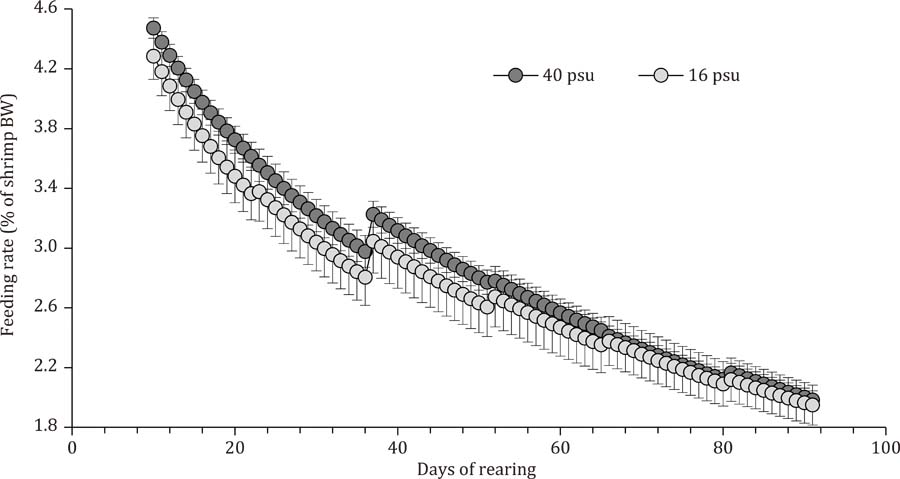
This study evaluated the effects of dietary crude protein (CP) and methionine (Met) levels on growth performance, feed utilization, and daily nutrient intake of juvenile Penaeus vannamei reared under 16 and 40 psu. A 2 × 3 × 2 factorial design tested six diets with CP levels (33.3 and 37.4%, as-is basis) adjusted via soy protein concentrate, and Met levels (0.6, 0.7, and 0.9%, as-is basis) supplemented with DL-methionine. Shrimp of 1.49 ± 0.11 g were fed for 91 days in 92 tanks of 0.5 m3 at 140 animals/m2. Salinity was the dominant factor affecting shrimp performance, significantly influencing survival, with higher rates observed at 40 psu (95.5 ± 4.5%) compared with 16 psu (90.7 ± 5.7%). However, a higher salinity negatively impacted final body weight (13.6 ± 1.2 vs. 11.4 ± 0.7 g), yield (13.8 ± 0.9 vs. 16.9 ± 1.6 MT/ha), weight gain (665.5 ± 44.5 vs. 816.1 ± 84.0%), specific growth rate (2.24 ± 0.06 vs. 2.43 ± 0.10%/day), and feed conversion ratio (1.46 ± 0.10 vs. 1.32 ± 0.08). Except for daily feed intake, shrimp reared at 16 psu consistently outperformed those at 40 psu (P<0.001). Dietary CP and Met levels did not significantly affect survival, yield, or other growth parameters (P>0.05), though raising CP and Met levels significantly increased daily CP and Met intake (P<0.001). Although shrimp at 40 psu showed increased intake of CP, Met, total sulfur amino acids, and total amino acids, this did not improve growth performance or feed utilization under hyperosmotic conditions. These findings suggest that elevated energy demands for osmoregulation in hyperosmotic environments limited nutrient conversion into growth, showing that dietary interventions were insufficient to fully overcome the challenges posed by high salinity.
Palavras-chave: feed utilization; methionine supplementation; Penaeus vannamei; suboptimal salinity