R. Bras. Zootec.29/set/2026;55:e20250255.
Progesterone supplementation on Day 7 after TAI improves reproductive performance, productivity, and economic efficiency in beef cow-calf systems
Thiago de Souza Vieira
 , Samuel Rodrigues Bonamichi do Couto
, Hugo Rocha Sabença Dias
, Nicolas Moreira Piedras Monnerat Caparelli
, Daniela Cristina Rocha de Freitas
, Greicy Sofia Maysonnave
, Rondineli Pavezzi Barbero
, Marco Roberto Bourg de Mello
, Samuel Rodrigues Bonamichi do Couto
, Hugo Rocha Sabença Dias
, Nicolas Moreira Piedras Monnerat Caparelli
, Daniela Cristina Rocha de Freitas
, Greicy Sofia Maysonnave
, Rondineli Pavezzi Barbero
, Marco Roberto Bourg de Mello
ABSTRACT
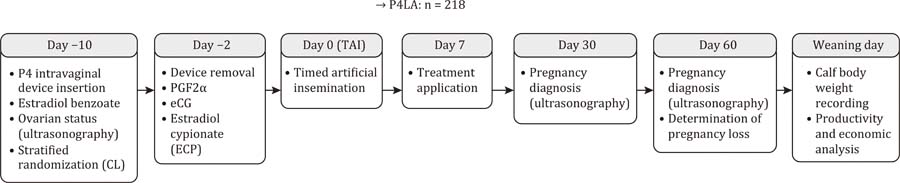
This study evaluated the technical and economic feasibility of long-acting progesterone (P4LA) supplementation in Nellore cows by assessing conception rates, pregnancy loss, cost per pregnancy, and progeny performance. A total of 452 cows (with a body condition score, BCS, ranging from 2.25 to 3.75) underwent a conventional three-handling timed artificial insemination (TAI) protocol. After TAI (D0), cows were allocated to a control group (n = 234; saline solution) or a P4LA group (n = 218; 150 mg, intramuscular, IM, administered on D7). Pregnancy diagnosis was performed by transrectal ultrasonography at 30 (D30) and 60 (D60) days of gestation. Cost per conception was calculated based on expenditures related to hormones, semen, labor, and supplies. P4LA-treated cows had higher conception rates at D30 (58.3% vs. 50.0%; P = 0.04) and D60 (52.7% vs. 42.3%; P = 0.02), with a tendency toward lower pregnancy loss (9.4% vs. 15.4%; P = 0.07). The cost per pregnancy was reduced in supplemented cows (CPC30: US$ 26.94 vs. 29.65; CPC60: US$ 29.65 vs. 35.08). Calves from supplemented cows had greater weaning weight (215.1 vs. 203.5 kg; P = 0.01), resulting in increased productivity per treated cow (95.7 vs. 72.2 kg of weaned calf). In conclusion, P4LA supplementation administered on Day 7 after TAI improved conception rates and was associated with a tendency toward reduced pregnancy loss, resulting in enhanced economic efficiency and productive performance, primarily driven by higher pregnancy rates and increased calf weaning weight in Nellore cows.
Palavras-chave: economic analysis; livestock; profitability; reproduction