R. Bras. Zootec.02/set/2026;55:e20250151.
The effect of male age, extender, cooling time and freezing method on post-thaw Brahman cattle sperm motility
Laura Murillo
 , Francisco Sevilla
, Ignacio Araya-Zúñiga
, Julio Rodríguez
, Rafael Molina-Montero
, Miguel Angel Silvestre
, Anthony Valverde
, Francisco Sevilla
, Ignacio Araya-Zúñiga
, Julio Rodríguez
, Rafael Molina-Montero
, Miguel Angel Silvestre
, Anthony Valverde
ABSTRACT
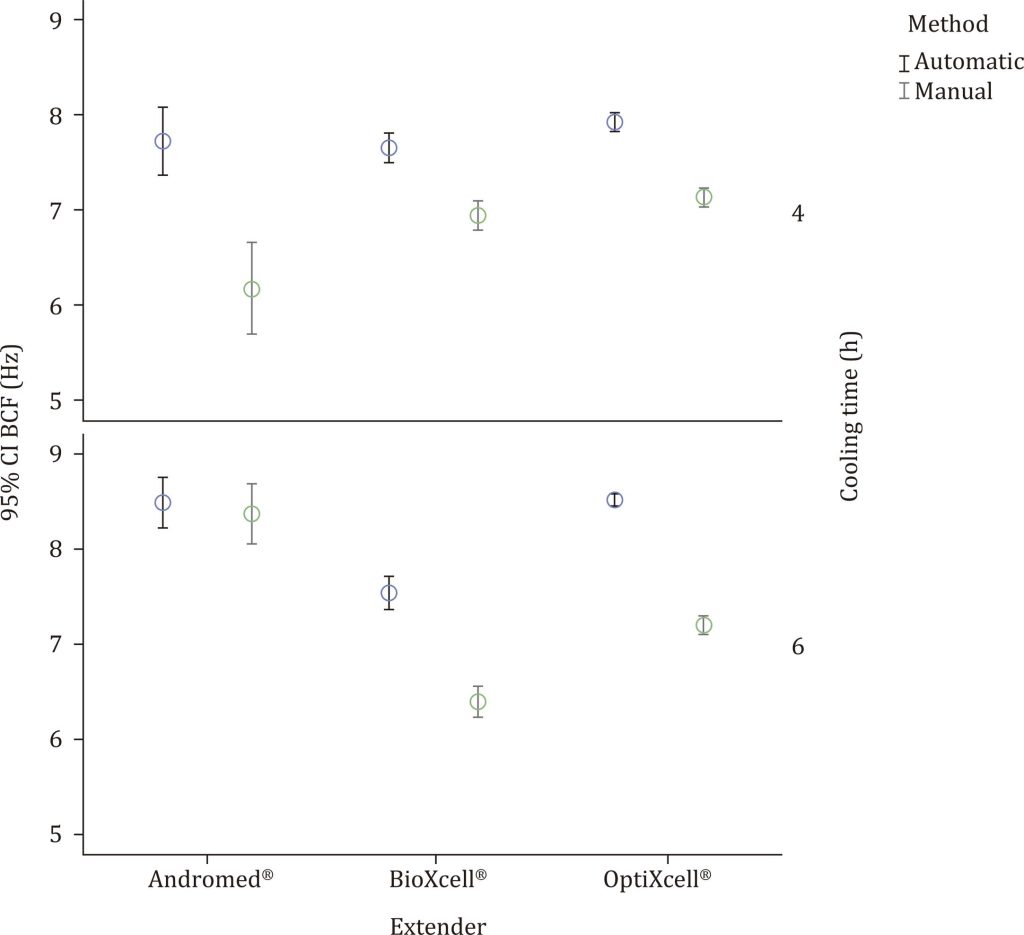
The objective of this study was to evaluate how male age, semen extender, cooling (equilibration) time and freezing method influence the quality of Brahman bulls’ sperm after cryopreservation, as measured by Computer-Assisted Sperm Analysis (CASA) parameters. Six Brahman bulls, with an average age of 48.6±11.5 months, were used. Two ejaculates were collected for each animal on different days, with an interval of approximately one week between collections. Semen was diluted with three extenders: Andromed®, BioXcell®, and OptiXcell®. The samples were equilibrated for either four or six hours and frozen using either static/manual or controlled programmable methods, resulting in 12 treatments for bovine semen cryopreservation. Results showed significant differences (P<0.05) in sperm motility and kinematics based on the extender used. Bull age had a significant effect (P<0.05) on the percentage of fast and medium sperm. Cooling time did not affect motility variables (P>0.05). No differences were found in total motility rate between freezing methods, but significant differences (P<0.05) were noted in sperm kinematic variables. Freezing of Brahman semen was more effective when samples were extended with OptiXcell®, cooled for 4 h, and frozen using an automatic method.
Palavras-chave: Bos indicus; livestock; reproduction; sex selection; spermatozoon; zebu cattle