R. Bras. Zootec.19/Dec/2025;54:e20240217.
Understanding the drivers of colostrum intake and pre-weaning mortality in piglets: an exploratory analysis with focus on neonatal vitality traits
Monalisa Fernandes Camargo
 , Gabriela Miotto Galli
, Alícia Zem Fraga
, Marcos Kipper
, Bruna Souza de Lima Cony
, Carolina Haubert Franceschi
, Gabriel Bueno Martins
, Jéssica Pereira Silva
, Melody Martins Cavalcante Pereira
, Alexandra Moller Alves
, Ines Andretta
, Gabriela Miotto Galli
, Alícia Zem Fraga
, Marcos Kipper
, Bruna Souza de Lima Cony
, Carolina Haubert Franceschi
, Gabriel Bueno Martins
, Jéssica Pereira Silva
, Melody Martins Cavalcante Pereira
, Alexandra Moller Alves
, Ines Andretta
ABSTRACT
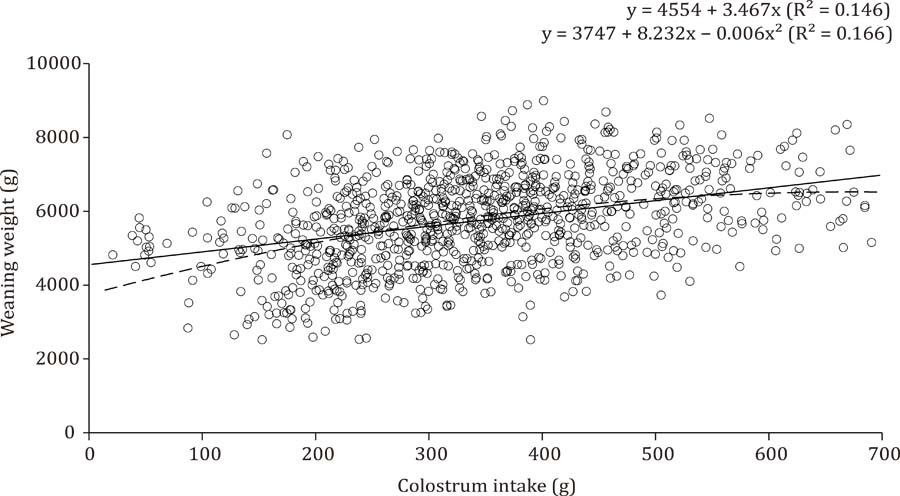
This study examined the effect of colostrum intake on pre-weaning mortality in piglets, focusing on neonatal vitality traits. Data from 2,050 piglets and 136 sows were collected from a commercial farm. Sows were monitored during gestation (parity, body condition, backfat thickness, weight gain, and gestation duration) and farrowing was monitored (duration, live births, mummified fetuses, stillbirths, maternal glucose, birth intervals, birth order, and sex). Neonatal traits (colostrum intake, meconium presence, umbilical rupture, rectal temperature, glucose, oxygenation, and heart rate) and performance measures (birth weight, weaning weight, and mortality) were recorded. Piglets that did not survive until weaning were born to sows with a longer farrowing duration (+26%; P<0.001), higher birth orders (+14%; P = 0.047), lower birth weights (−21%; P<0.001), reduced oxygenation (−1%; P = 0.019), lower rectal temperatures (−4%; P = 0.033), and significantly lower colostrum intake (−38%; P<0.001). Mortality was associated with rectal temperatures (<38.35 °C), colostrum intake (<172 g), birth weights (<897.5 g), and farrowing durations (>301 min), as identified by a tree-based model. Low colostrum intake correlated with longer farrowing durations (+7%; P = 0.044), longer birth intervals (+32%; P = 0.013), higher birth orders (+12%; P = 0.015), lower body weights (−5%; P = 0.005), reduced umbilical rupture rates (−11%; P = 0.049), lower rectal temperatures (−1%; P = 0.046), and lighter weaning weights (−10%; P<0.001). The model suggested that low colostrum intake was linked to birth weight (<990 g), sow body condition during gestation, and farrowing durations (>343 min). These results underscore the complex factors influencing colostrum intake and mortality, critical for sustainable swine production.