R. Bras. Zootec.29/Mar/2019;48:e20170298.
Optimization of solid-state fermentation conditions of Bacillus licheniformis and its effects on Clostridium perfringens-induced necrotic enteritis in broilers
En-Ru Lin
 , Yeong-Hsiang Cheng
, Felix Shih-Hsiang Hsiao
, Witold S. Proskura
, Andrzej Dybus
, Yu-Hsiang Yu
, Yeong-Hsiang Cheng
, Felix Shih-Hsiang Hsiao
, Witold S. Proskura
, Andrzej Dybus
, Yu-Hsiang Yu
ABSTRACT
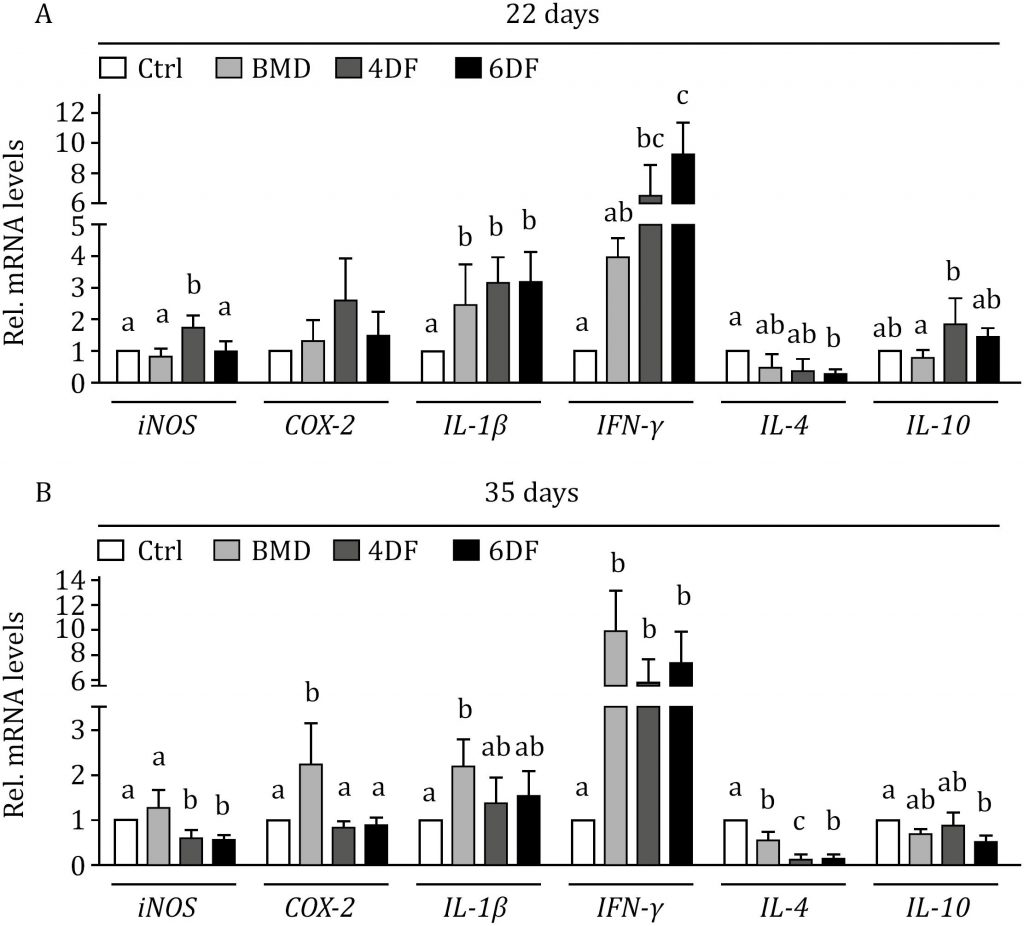
In the present study, we examined the growth parameters of Bacillus licheniformis in solid-state fermentation (SSF) and evaluated the effects of Bacillus licheniformis-fermented products on Clostridium perfringens-challenged broilers. During four and six days of SSF, the highest viable biomass was observed at 5% glucose, 10% soybean meal, 3% yeast, and 50% initial moisture content. The Bacillus licheniformis SSF products were heat- and acid-resistant. Furthermore, the fermented products were able to inhibit the growth of Clostridium perfringens and Staphylococcus aureus in vitro. In feeding experiments, in a similar manner to the antibiotic treatment group, dietary supplementation of Bacillus licheniformis-fermented products significantly improved intestinal morphology and necrotic lesions under Clostridium perfringens challenge, accompanied by increased IFN-γ mRNA expression in the spleen and bursa of Fabricius. These results together suggest that Bacillus licheniformis-fermented products have potential for development as feed additives and use as possible substitutes for antibiotics to treat Clostridium perfringens in the poultry industry.
Keywords: broiler; disease; fermentation; probiotics