R. Bras. Zootec.17/Jul/2026;55:e20240197.
Economics, risk analysis, and sustainability of minimum module for pasture-based beef production: a case study in Campo Grande, MS, Brazil
Michael Allim Jorge
 , Durval Dourado Neto
, Roberto Daniel Sainz
, Lucilio Rogerio Aparecido Alves
, Sila Carneiro da Silva
, Sergio de Zen
, Klaus Reichardt
, Durval Dourado Neto
, Roberto Daniel Sainz
, Lucilio Rogerio Aparecido Alves
, Sila Carneiro da Silva
, Sergio de Zen
, Klaus Reichardt
ABSTRACT
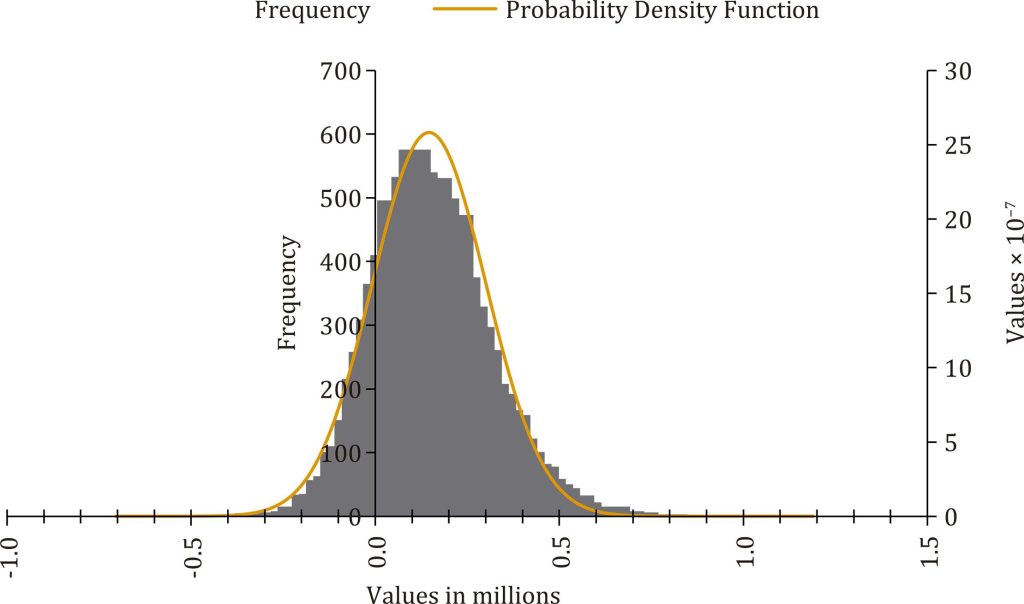
This study quantified production risks and economic feasibility in tropical pasture-based beef systems by integrating a rule-based Minimum Module (MM) framework with Monte Carlo simulation (@Risk 8.0) in Excel 365 using a Microsoft Visual Basic 6.0 algorithm. Twelve scenarios combining low (0.5 animal unit [AU] ha⁻1), medium (1.0 AU ha⁻1), and high (1.5 AU ha⁻1) stocking rates across 2017–2020 were each run with 10,000 stochastic iterations to identify the smallest viable herd size and pasture area that ensured non-negative net present value (NPV ≥ 0). Intensification increased per-hectare productivity from 3.3 to 9.8 arrobas ha⁻1 yr⁻1 (P<0.001) and reduced minimum grazing area by 53–63 percent (P<0.001). Risk profiles remained favorable, with negative gross margin in only 0.25% of iterations and negative total profit in 15.55% of iterations. Fixed-cost share declined from approximately 74% in low-intensity to approximately 48% in high-intensity systems (P<0.05). Strong co-movement among overhead inputs (ρ>0.90) and among variable-cost inputs (ρ>0.80), and a land-for-feed trade-off (ρ ≈ –0.35) were quantified. The MM tool delivers transparent “what-if” scenario testing for herd and land planning without complex optimization, enabling data-driven feed-price hedging and stocking-rate adjustments.