R. Bras. Zootec.17/Jul/2026;55:e20250100.
Timing of corn grain feeding during fattening: effects on animal performance, carcass characteristics, and meat quality
Soledad Alonso Ramos
 , Laura B. Pouzo
, Carlos Sebastian Maglietti
, María Laura Testa
, Susan K. Duckett
, Enrique Pavan
, Laura B. Pouzo
, Carlos Sebastian Maglietti
, María Laura Testa
, Susan K. Duckett
, Enrique Pavan
ABSTRACT
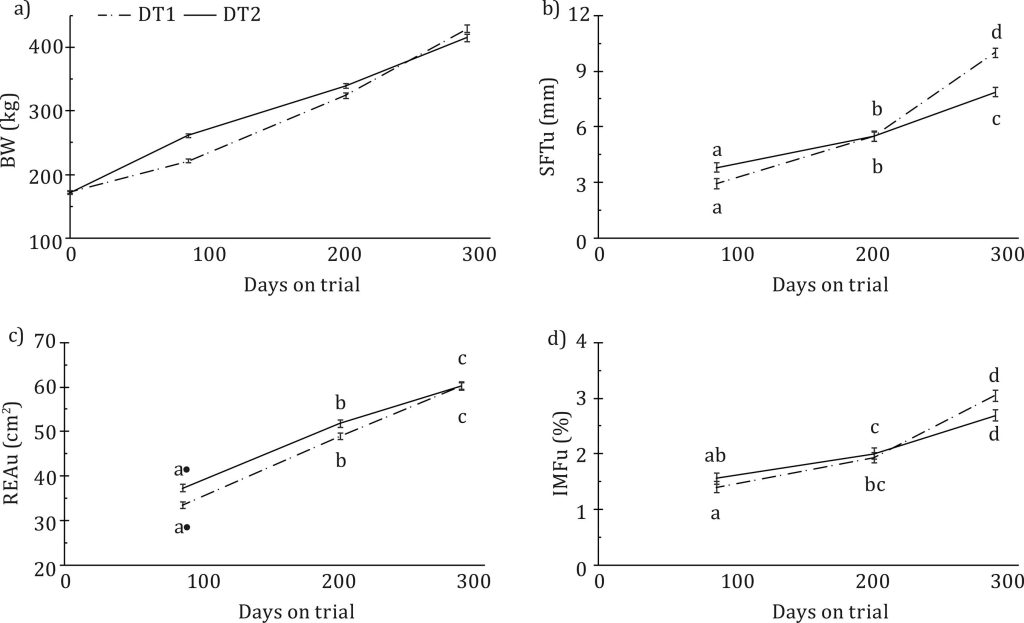
The study evaluates the impact of feeding the same amount of corn grain at different times on animal production, carcass characteristics, and meat quality. At weaning, 60 steers (176 kg) were divided into six groups assigned to one of two dietary treatments (n = 3). In dietary treatment one (DT1), steers grazed an endophyte-free tall fescue pasture to 330 kg of LW and then (Phase-3) were fed a corn grain-based diet for 90 d before slaughter. In dietary treatment two (DT2), steers were fed a cracked corn grain-based diet for 90 d after weaning (Phase-1) and then grazed until slaughter, being supplemented with cracked corn grain in Phase-3. To reach the same total amount of grain intake in both treatments, in Phase-3, DT2 was supplemented with the amount of grain being fed to DT1 minus DT2 average grain intake in Phase-1. The average daily gain in DT1 was lower in Phase-1 than in DT2, but greater in Phase-2 and Phase-3. Final live weight, hot carcass weight, ribeye area and subcutaneous fat thickness were greater (P<0.50) in DT1 than in DT2, but marbling score and intramuscular fat content did not differ (P>0.100). Meat from DT1 had greater L*, a*, and b* values than DT2 (P<0.05), but the subcutaneous fat had a lower b*-value (P<0.001). The longissimus dorsi muscle shear-force did not differ (P = 0.255), and minor differences were observed in meat fatty acid composition. The n-6:n-3 ratio and C18:1 trans-10/trans-11 proportion were greater (P<0.050), and the C20:5 proportion was lower (P = 0.002) in DT1 than in DT2. Thus, the corn grain feeding strategy during the fattening period did not affect meat marbling score or intramuscular fat content, shear force, or fatty acid profile, but did affect meat color as well as subcutaneous fat thickness and color.
Keywords: beef; color; grazing; intramuscular fat; marbling; shear force