R. Bras. Zootec.29/Aug/2025;54:e20240099.
Impact of linear-type traits measured at first lactation on the productive life of Holstein cows
Lorena Carla Gomes Vernaschi
 , Altair Antonio Valloto
, Lenira El Faro Zadra
, Rodrigo de Almeida Teixeira
, Laila Talarico Dias
, Altair Antonio Valloto
, Lenira El Faro Zadra
, Rodrigo de Almeida Teixeira
, Laila Talarico Dias
ABSTRACT
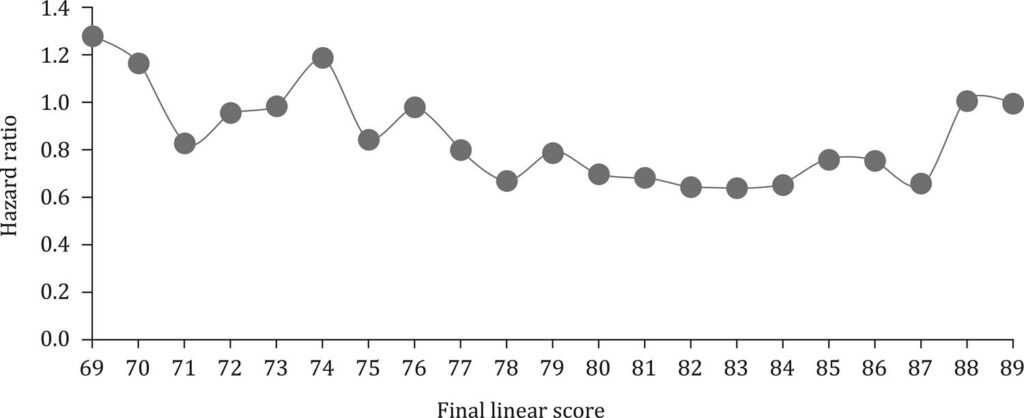
The objective of this study was to identify how linear-type traits impact the culling risk and which traits are most associated to productive life of Holstein cows. Linear classification and test-day milk yield data of 34,653 primiparous cows obtained from the database of Associação Paranaense de Criadores de Bovinos da Raça Holandesa were used. Survival analysis was performed by PHREG procedure of SAS/STAT 9.4 using a Cox regression model. The model considered herd and year of the linear classification (2010 to 2019) as fixed effects and the linear effects of 305-day cumulative milk yield in first lactation (kg), age at first calving (months), the individual traits, and final score as covariables. Cows with intermediate rump angle (score 6) had the lowest culling risk. The culling risk for cows with inverted rumps (score 1) was four times greater than for cows with inclined rump (score 9). Females with moderately curved rear legs, side view, were more likely to remain for a longer period in the herd. Cows with extremely high and strongly attached udders had the lowest culling risk (1.0). Classification at first calving may be a strong indicator of long productive life of Holstein cows. Females rated as Good Plus or Very Good tend to remain in the herd longer. The traits of the mammary system have the most impact on the length of productive life.
Keywords: linear classification; longevity; survival analysis