R. Bras. Zootec.24/Apr/2026;55:e20240110.
Financial analysis of a dairy farm in the state of Rio Grande do Sul in 2022
Ederson dos Santos
 , Leonardo Marins
, Eduardo Gularte Xavier
, Uriel Secco Londero
, Cleber Souza Martins
, Marcio Nunes Corrêa
, Leonardo Marins
, Eduardo Gularte Xavier
, Uriel Secco Londero
, Cleber Souza Martins
, Marcio Nunes Corrêa
ABSTRACT
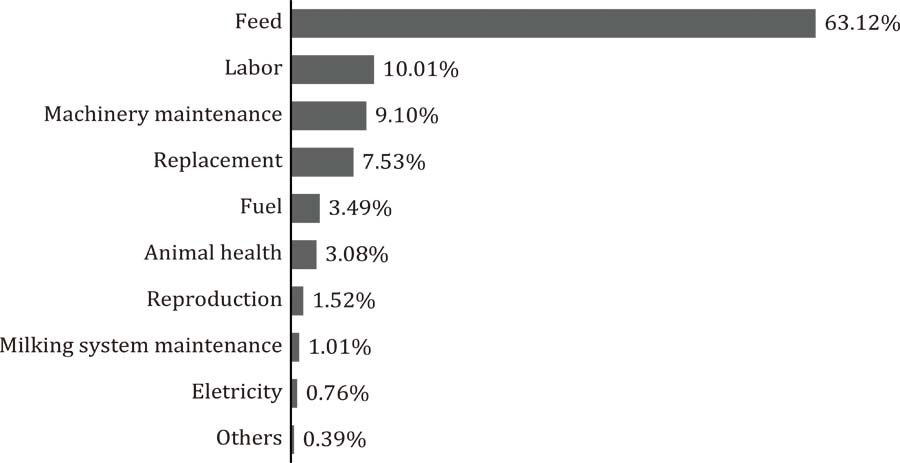
The objective of this study was to perform a financial analysis of a dairy farm located in the southern region of Rio Grande do Sul, comprising 500 hectares and a herd of 380 lactating Holstein cows, with an average daily milk production of 12,000 liters, during the year 2022. Based on the collected data, the total revenue (TR), fixed and variable costs and expenses were analyzed monthly and for the entire period. Additionally, operating profit (OP), contribution margin (CM), percentage contribution margin (CM%), break-even point (BEP), and break-even point output (BEP output) were calculated. A vertical analysis was conducted to determine the cost share in producing one liter of milk. The average revenue, costs and expenses, and gross profit per liter of milk were US$ 0.47 (R$ 2.41), US$ 0.40 (R$ 2.05), and US$ 0.07 (R$ 0.36), respectively. The CM and CM% were equal to US$ 815,036.08 and 39.84%, respectively. The BEP was equal to US$ 1,248,297.34, and the BEP output was 2,660,396.5 liters of milk. The most significant production costs were related to feed, accounting for 63.12% of the total cost. Labor and machinery maintenance ranked the second and third largest cost components, representing 10.01% and 9.10%, respectively. Except for the month of March, revenues exceeded costs and expenses throughout the year 2022 on the studied farm. The financial analysis of the property supports the adoption of strategies aimed at increasing profitability.
Keywords: agribusiness; dairy production cost; farm management