R. Bras. Zootec.11/Sep/2026;55:e20250244.
Developmental factors and genetic groups evaluated by computational modelling for pregnancy prediction when mating at 14 months of age
Ricardo Zambarda Vaz
 , Guyomar Ubyrathan Ramos
, Rangel Fernandes Pacheco
, Rafael Espigolan
, Cristian Faturi
, Mariana Assis Borges
, Bibiana Teixeira Rodrigues
, João Restle
, Guyomar Ubyrathan Ramos
, Rangel Fernandes Pacheco
, Rafael Espigolan
, Cristian Faturi
, Mariana Assis Borges
, Bibiana Teixeira Rodrigues
, João Restle
ABSTRACT
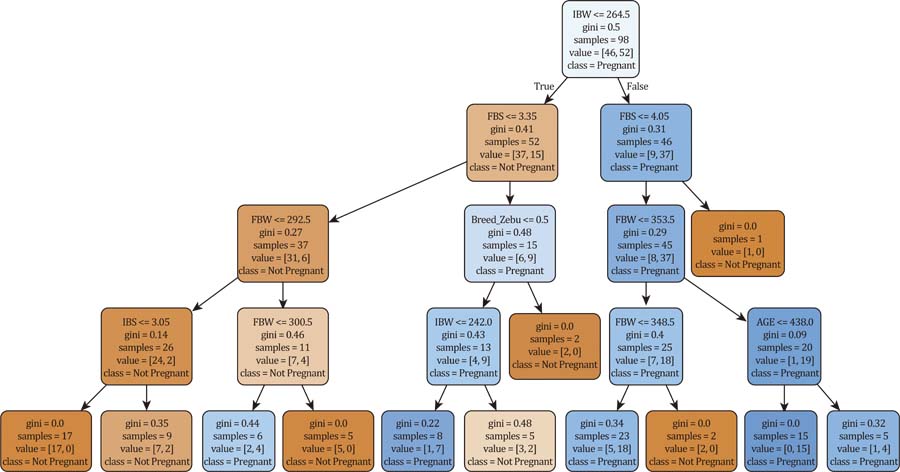
The aim of this study was to predict pregnancy in beef heifers, identifying the most impactful variables using computational modelling. Developmental data of 98 heifers up to 480 days (16 months) of age (Charolais, Nellore, and their crossbreeds) were used. At the beginning and end of the mating season initial body weight (IBW), initial body condition score (IBS), final body weight (FBW), and final body condition score (FBS) were assessed. The age at the start of the mating season (AGE), and the genetic composition of the heifers were also evaluated. Principal Component Analysis (PCA) was carried out, where the first two components (PC1 and PC2) explained 60.7% of the total variance in the data. The PCA biplot revealed a separating trend, with PC1 (44.6%) associated with weight and age, while PC2 (16.1%) was related to the body condition score and genetics. A random forest (RF) model was then developed and trained to classify pregnancy status, achieving an area under the ROC curve (AUC) of 0.80, showing the model to have discriminatory power. The variables with the greatest predictive importance were IBW (30.1%), EBW (19.9%), IBS (14.4%), and EBS (12.4%). Nellore genetics is the main factor for pregnancy, followed by variables related to development, nutritional status and age. The combination of PCA and RF proved to be a reliable approach for identifying critical factors and predicting reproductive success in beef heifers.