R. Bras. Zootec.03/Nov/2025;54:e20240145.
Carcass and meat traits from Moura pigs raised under rotational grazing in southern Brazil
Sebastião Ferreira Magagnin
 , Meire Luiza Wirth
, Kaline Alessandra Lima de Sá
, Luara Karina Maccari
, Luana Burake
, Sandra Regina Souza Teixeira de Carvalho
, Geisson Marcos Nardi
, Juliana Sperotto Brum
, Teresinha Marisa Bertol
, Lucélia Hauptli
, Marson Bruck Warpechowski
, Giustino Tribuzi
, Meire Luiza Wirth
, Kaline Alessandra Lima de Sá
, Luara Karina Maccari
, Luana Burake
, Sandra Regina Souza Teixeira de Carvalho
, Geisson Marcos Nardi
, Juliana Sperotto Brum
, Teresinha Marisa Bertol
, Lucélia Hauptli
, Marson Bruck Warpechowski
, Giustino Tribuzi
ABSTRACT
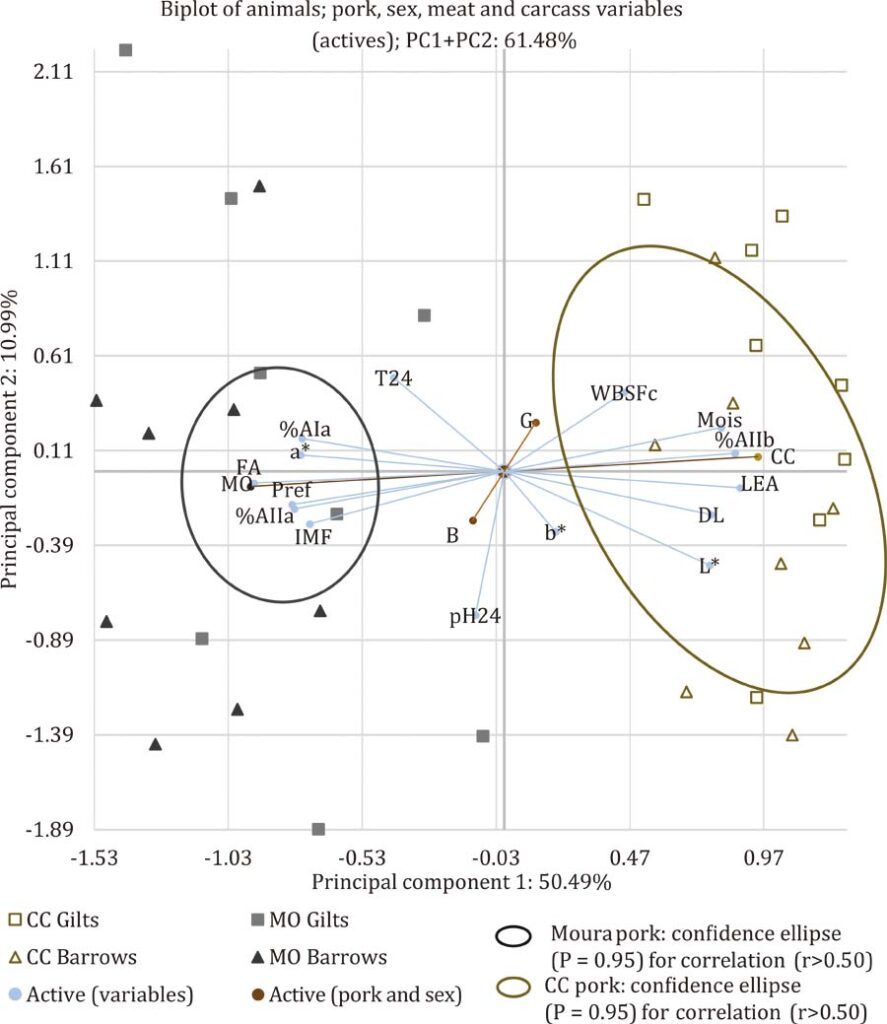
This study aimed to characterize carcass, meat quality, sensory and textural parameters, as well as muscle fiber types from 16 Moura pigs, as a local pig raised in outdoor production system, and evaluate differences with 16 conventional commercial (CC) pigs, raised intensively, representing the principal pork type, widely available in national market. Carcass measurements, liquid loss and cooked pork texture tests, proximal composition analysis of pork and backfat, and sensory evaluations with 104 pork consumers were carried out. The statistical arrangement used was bifactorial blocks: pork type and sex (2 × 2) in two blocks. Moura pigs had greater carcass lipid deposition and intramuscular fat (IMF) (3.51 vs 1.91 g/100 g) than CC pigs (P<0.01), while CC pigs had greater lean tissue deposition and drip loss (6.44 vs. 2.88%) (P<0.01). Moura pork backfat presented a higher luminosity and lipid content and lower moisture content, and red and yellow values than CC backfat (P<0.03), while Moura pork was darker and redder than CC pork (P<0.01). Moura pork had larger relative areas of oxidative (Ia) (11.19 vs. 7.32%) and intermediate (IIa) (22.81 vs 11.70%) muscle fibers, while CC pork had higher glycolytic fibers (80.98 vs 66.00%) relative areas (P<0.01). Hardness, gumminess, and chewiness parameters from CC cooked pork had higher values than moura pork (P<0.01). Panelists preferred cooked Moura pork (72 vs. 28%) to CC pork (P<0.01). Differences in backfat characteristics between CC and Moura pork are attributed to greater lipid backfat content in Moura pork. The greater proportion of Ia and IIa muscle fibers contribute to Moura pork color, combined with a greater IMF content and less liquid loss, contributing to greater tenderness and juiciness Moura pork, preferred by consumers.