R. Bras. Zootec.21/Jul/2020;49:e20190145.
Association of the forage management practices, weaning rate, and factors that influence technological adoption in beef cattle production
Matheus Dhein Dill
 , Paulo Rodrigo Ramos Xavier Pereira
, João Armando Dessimon Machado
, Gabriel Ribas Pereira
, Vitor Francisco Dalla Corte
, Odilene de Souza Teixeira
, Júlio Otávio Jardim Barcellos
, Paulo Rodrigo Ramos Xavier Pereira
, João Armando Dessimon Machado
, Gabriel Ribas Pereira
, Vitor Francisco Dalla Corte
, Odilene de Souza Teixeira
, Júlio Otávio Jardim Barcellos
ABSTRACT
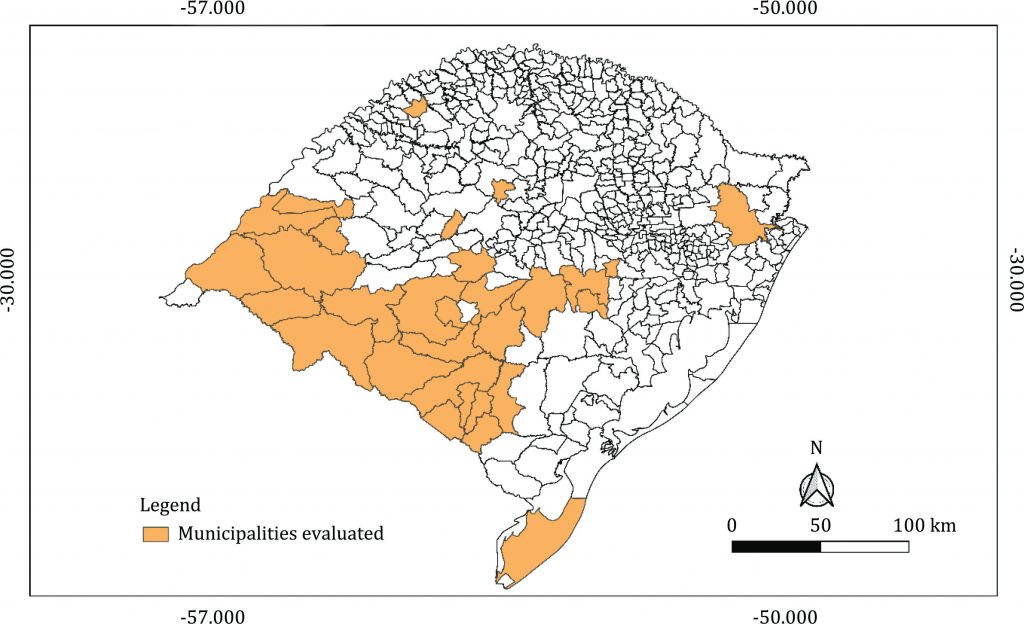
The objective of this study was to verify the association of improved native grassland and winter and summer pastures on the weaning rate in beef cattle production. Subsequently, we also verified the socioeconomic and productive characteristics related to the adoption of technologies to increase the weaning rate of the farmers. The survey was conducted with 73 producers of Hereford and Braford cattle in the state of Rio Grande do Sul, Brazil. A data analysis was performed using the minimum ordinal squares method and the regression analysis (Tobit). The results showed that cattle farmers who adopt winter pastures have greater weaning rates, and the factors that influence this adoption are related to a greater number of employees on the farm and the use of a crop-livestock production system. In addition, farmers who receive a greater number of technical assistance visits per year are more likely to adopt winter pastures and improved native grassland. This information can be useful in the formulation of technological dissemination programs that aim at a sustainable production of beef cattle.
Keywords: cultivated pasture; native grassland; production system; weaning