R. Bras. Zootec.07/Oct/2026;55:e20250083.
β-mannanase-supplemented diets containing xylanase reduced by 85 kcal of metabolizable energy/kg promotes benefits in fecal alpha diversity in lactating sows
Janaína Paolucci Sales de Lima
 , Eliane Fátima Rocha Engelsing
, Jansller Luiz Genova
, Amanda Gabriela Bickel
, Mateus Boelhouwer
, Ricardo Vianna Nunes
, Paloma Amorim Vaz
, Rodrigo Henrique Risso Aires Alves
, Caroline Cintra Rodrigues
, Angela Rocio Poveda-Parra
, Silvana Teixeira Carvalho
, Marcos Kipper
, Cinthia Eyng
, Leandro Batista Costa
, Paulo Levi de Oliveira Carvalho
, Eliane Fátima Rocha Engelsing
, Jansller Luiz Genova
, Amanda Gabriela Bickel
, Mateus Boelhouwer
, Ricardo Vianna Nunes
, Paloma Amorim Vaz
, Rodrigo Henrique Risso Aires Alves
, Caroline Cintra Rodrigues
, Angela Rocio Poveda-Parra
, Silvana Teixeira Carvalho
, Marcos Kipper
, Cinthia Eyng
, Leandro Batista Costa
, Paulo Levi de Oliveira Carvalho
ABSTRACT
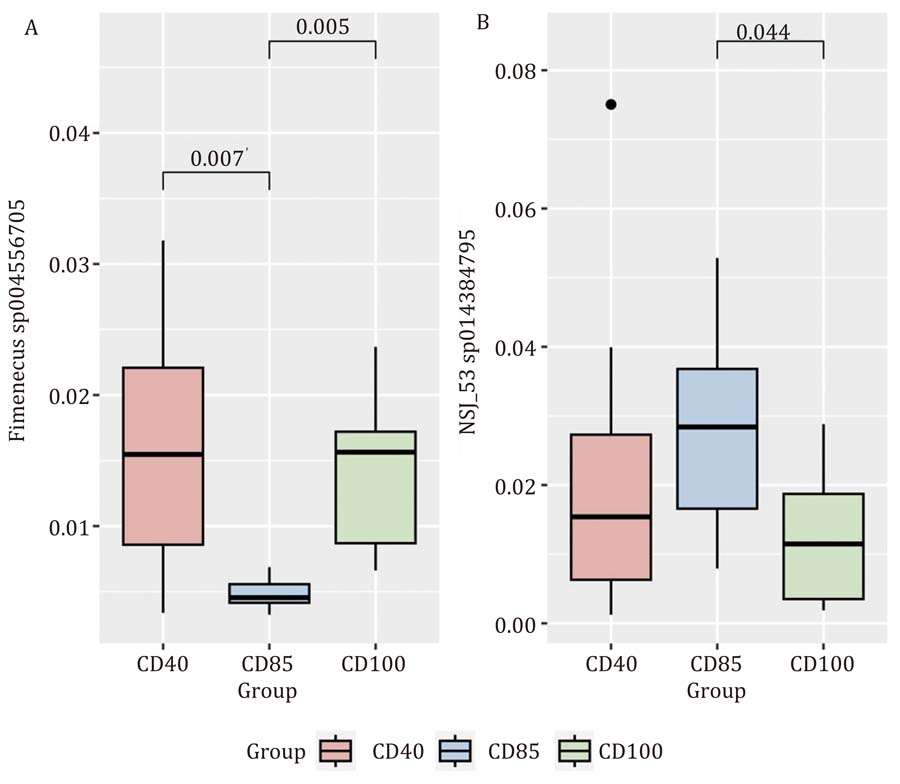
Enzyme-supplemented diets can influence the intestinal microbiome in an intricate interplay with the immune system. Therefore, the effects of β-mannanase supplementation in metabolizable energy (ME)-reduced diets containing xylanase were investigated on cytokine concentrations and fecal microbiota profile in lactating sows (n = 60, 248.4 ± 2.4 kg) assigned to a randomized block design with three dietary treatments: a diet containing xylanase (Control; reduction of 40 kcal of ME/kg, CD40), CD40 + β-mannanase (0.3 g/kg) and a reduction of 45 kcal ME/kg (CD85), and CD40 + β-mannanase (0.3 g/kg) and reduction of 60 kcal ME/kg diet (CD100). The ME reduction in CD40, CD85, and CD100 diets was based on a requirement of 3,400 kcal/kg, with diets formulated to contain to have 3,360, 3,315, and 3,300 kcal/kg, respectively. The study period lasted 26 days. Serum cytokines and fecal microbiota were assessed on day 18 and 21, respectively. The fecal microbiota profile was characterized by 16S rRNA gene sequencing. Sows fed CD85 had (P = 0.014) higher alpha diversity richness than CD100 based on the Simpson index. The Acutalibacteraceae family was more abundant (P = 0.044) with CD100 than CD85, but CAG-508 and NSJ_53 families exhibited (P<0.05) a higher abundance in sows fed CD85 than CD100. The Fimenecus genus exhibited (P<0.05) a lower abundance on CD85 compared to CD40 or CD100, while the NSJ-53 genus showed (P = 0.044) a higher abundance in sows fed CD85 diet than in those fed the CD100 diet. Similarly, were observed (P<0.05) for the Fimenecus sp004556705 and NSJ-53 sp014384795 species. In conclusion, a diet supplemented with β-mannanase and containing xylanase reduced by 85 kcal/kg fed to lactating sows positively affected fecal alpha diversity.