R. Bras. Zootec.21/May/2026;55:e20250114.
Effect of lysine restriction on compensatory growth, body composition and nitrogen balance of immunocastrated pigs
Cleslei Alisson Silva
 , Danilo Alves Marçal
, Alícia Zem Fraga
, Alini Mari Veira
, Marllon José Karpeggiane de Oliveira
, Graziela Alves da Cunha Valini
, Antonio Diego Brandão Melo
, Gustavo Freire Resende Lima
, Luciano Hauschild
, Danilo Alves Marçal
, Alícia Zem Fraga
, Alini Mari Veira
, Marllon José Karpeggiane de Oliveira
, Graziela Alves da Cunha Valini
, Antonio Diego Brandão Melo
, Gustavo Freire Resende Lima
, Luciano Hauschild
ABSTRACT
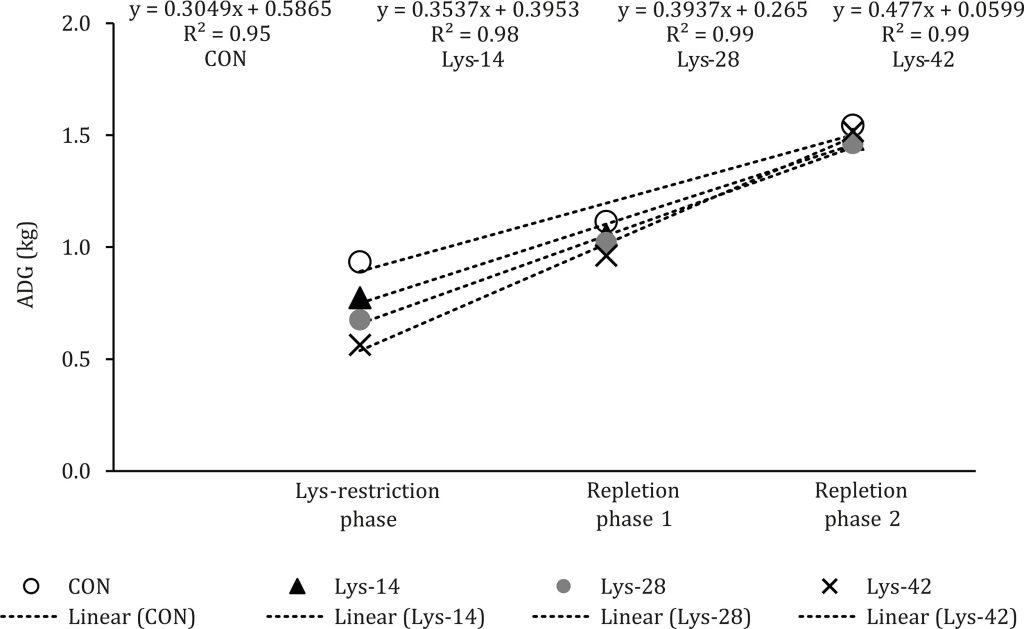
This study aimed to evaluate the effects of lysine (Lys) restriction on compensatory growth, body composition, and nitrogen balance of growing-finishing pigs before and after immunocastration. Sixty-four entire male pigs (39.2 ± 6.8 kg) were randomly assigned one of four treatments: Control diet (CON; no restriction) or diets with restriction of Lys level in 14 (Lys-14), 28 (Lys-28) and 42% (Lys-42) of estimated Lys requirements for entire growing pigs (Lys restriction phase, from 0 to 28 d). From 29 to 64 d, all animals received the same diet, formulated to meet the nutritional requirements of entire males (repletion phase 1). Repletion phase 2 (from 65 to 86 d) began immediately after the administration of the second dose of immunocastration. The CON diet and common diets fed from 29 to 64 d and 65 to 86 d were formulated to meet or exceed nutrient requirements. Growth performance and body composition variables reduced linearly (P≤0.05) as dietary Lys restriction increased, except for the final body lipid which tended to reduce linearly (P<0.10). In the repletion phase 1, no difference was observed for average daily feed intake (ADFI), ADG and G:F (ADG/ADFI) among pigs previously fed CON and Lys-restricted diets regardless of the restriction degree (P>0.05). Final body weight (BW) and final body protein were similar between the groups of pigs previously fed CON or Lys-14 diets (P>0.05). At the end of the repletion phase 2, pigs previously fed CON diet had similar final body protein than pigs previously fed Lys-14 or Lys-28 diets. Regarding the highest Lys restriction evaluated (Lys-42), a total catch-up was evidenced only for the final body weight.
Keywords: amino acid; catch-up; precision feeding; protein deposition; uncastrated male